
13.07.2026.
7th Meeting of the LIFE CROLIS Project Advisory Board
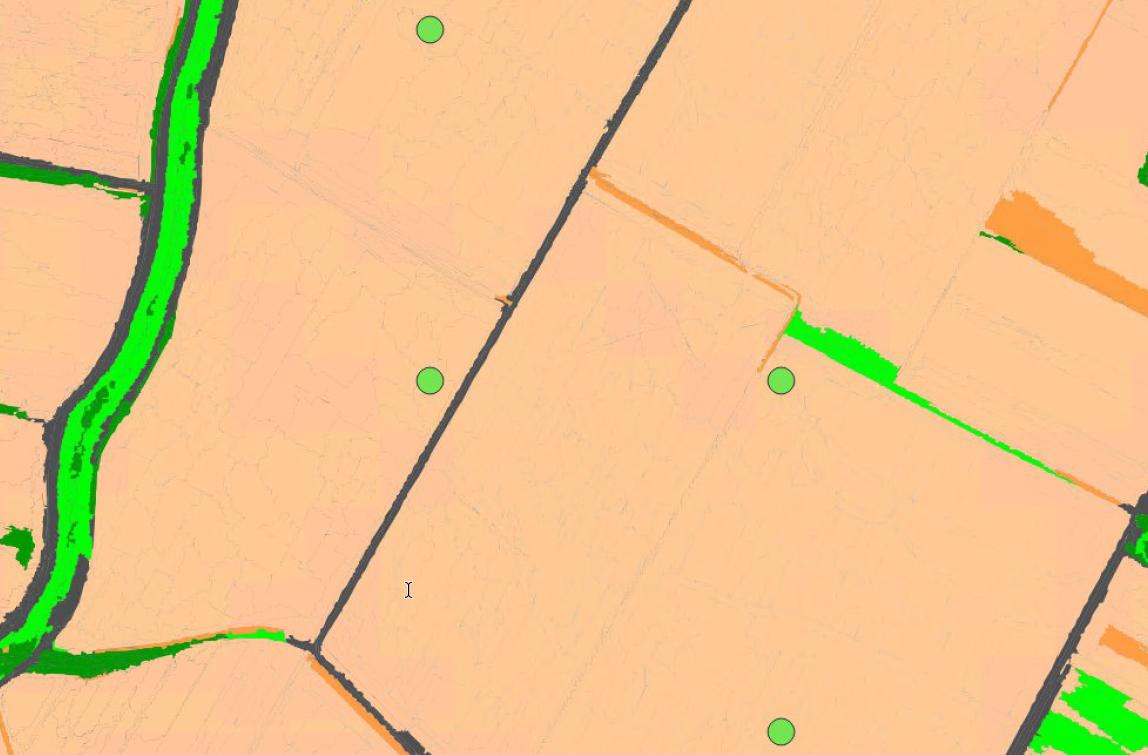
The first part of the 7th Meeting of the LIFE CROLIS Project Advisory Board was organized in two workshops held on 16 June and 1 July 2026. The workshops were dedicated to the development of the national Land Cover layer for the reference year 2020. In addition to the members of the Advisory Board, the workshops were attended by renowned European experts in land monitoring and remote sensing, including Mr. Steffen Fritz, PhD from the International Institute for Applied Systems Analysis (IIASA), Austria, and Prof. Martin Herold, PhD from the GFZ Helmholtz Centre for Geosciences (GFZ), Germany. Representatives of the Faculty of Geodesy, University of Zagreb, also participated and presented the updated methodology. These workshops simultaneously served as the final workshops for fine-tuning the system developed under Project Action C1.
The 7th Meeting of the LIFE CROLIS Project Advisory Board was organized in a hybrid format, both in Zagreb and online, through two workshops held on 16 June and 1 July 2026.
During the first workshop, held on 16 June 2026, representatives of the Ministry of Environmental Protection and Green Transition, the Paying Agency for Agriculture, Fisheries and Rural Development, the State Geodetic Administration, Croatian Forests Ltd., EKONERG Ltd., and the Faculty of Geodesy, University of Zagreb, participated, together with international experts from the Environment Agency Austria (EAA) and the International Institute for Applied Systems Analysis (IIASA).
Particular emphasis was placed on the development of Croatia’s national land cover layer using advanced geoinformation technologies, LiDAR data, Sentinel satellite imagery, and machine-learning methods.
Experts from the Faculty of Geodesy presented the current results of land cover classification for the continental and Mediterranean regions of Croatia. Preliminary results indicate very high classification accuracy in continental areas, while additional methodological improvements are planned for the karst landscapes of Dalmatia.
The international experts provided a number of recommendations for further improvement of the methodology, particularly regarding terminology, validation of results, and the processing of complex landscape types. The application of innovative satellite-derived data and advanced analytical methods was especially praised and recognized as an example of good practice at the European level.
The participants concluded that the project is progressing according to plan and that delivery of the national land cover layer for the reference year 2020 is still expected in September 2026. The recommendations received will be incorporated into the further development of the methodology.
The second workshop, held on 1 July 2026, brought together representatives of the Ministry of Environmental Protection and Green Transition, the Paying Agency for Agriculture, Fisheries and Rural Development, the State Geodetic Administration, Croatian Forests Ltd., the Faculty of Geodesy, University of Zagreb, EKONERG Ltd., and international experts from Germany and the United Kingdom.
The international experts commended the progress achieved so far and the use of innovative satellite-data processing techniques, while providing further recommendations for improving classification procedures, data validation, and alignment with European standards. The importance of developing a sustainable long-term national land monitoring system capable of supporting climate, agriculture, forestry, nature conservation, and spatial-planning policies was highlighted.
The participants concluded that the LIFE CROLIS project represents a significant step forward in the development of a modern land monitoring system in the Republic of Croatia. Completion of the national land cover layer for 2020 is expected during 2026, and the resulting datasets will provide a foundation for future monitoring of land-cover and land-use changes at the national level.
The continuation of the 7th Meeting of the Project Advisory Board is planned for September 2026, when further project results and progress will be presented.
Share this news: